
Buying Kitchen Knives
Finding the right knife can be extremely important for a chef. Over the years, most chefs will find a brand of kitchen knife they are most comfortable with. While some knives can be used for a majority of tasks, many knives have specific purposes within the kitchen.
Style of Knives
There are two common types of blade shape, French and German. German knives are more deeply and continuously curved along the whole cutting edge. French has an edge that is straighter until the end and then curves up to the tip. Knives either feature a curve near the tip, as in a chefs knife, or are straight for their entire length. The edge itself is smooth, serrated or scalloped. The point may differ in shape; most common is a sharp, triangular point, as in a chefs knife or paring knife, though the French point, also called ‘sheepsfoot’ is common in santokus, and a round point is sometimes found on long slicing knives.
Serrated vs smooth blade
A serrated blade has a cutting edge that has many small points of contact with the material being cut. By having less contact area than a smooth blade, the applied pressure at each point of contact is relatively greater and the points of contact are at a sharper angle to the material being cut. Cuts made with a serrated blade are typically less smooth and precise than cuts made with a smooth blade. They can be more difficult to sharpen using a whetstone or rotary sharpener than a non-serrated; however, they can be easily sharpened with a sharpening steel.
Fully forged/one piece
A fully forged knife is one where both the blade and tang are made from one single piece of steel. This means it has no weak points and is extremely strong, while achieving a better balance and ease of use. This means they are perfect for cutting meat and vegetables.
Stamped and forged blades
Stamped blades are cut to shape directly from cold-rolled steel, heat-treated for strength, then ground, polished, and sharpened. Several popular knife brands such as Global use stamped and heat-treated blades in their premium knives. Forged blades are made in an intricate, multi-step process, often by skilled labourers. A chunk of solid or powdered steel alloy is heated to a high temperature, and pounded while hot to form it. The blade is then heated above critical temperature, quenched in an appropriate quenchant, and tempered to the desired hardness. After forging and heat-treating, the blade is polished and sharpened. Forged blades are typically thicker and heavier than stamped blades.
Chefs / cooks knife

The chefs knife, also known as a cooks knife, was originally designed to slice and disjoint large cuts of beef. They generally have a blade eight inches in length and 1½ inches in width, although models range from six to 14 inches in length. A modern chefs knife is designed to perform well at many different kitchen tasks; it can be used for mincing, slicing and chopping vegetables, slicing meat and disjointing large cuts.
Fillet knife
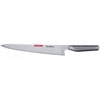
The fillet knife has a flexible and thin blade, which makes it perfect for reaching places that are impossible with a chefs knife. The flexible blade and thin metal make filleting knives perfect for slicing fish and other soft meats. Fillet knife blades average between four and nine inches in length.
Boning knife

A boning knife is used to remove bones from cuts of meat. It has a thin, flexible blade with a sharp point, usually about five or six inches long. A stiff boning knife is good for beef and pork, and a flexible one is preferred for poultry and fish.
Bread knife
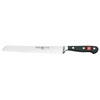
Bread knives are usually between six and 10 inches. An offset serrated knife uses an offset handle to ensure the cook's knuckles will not touch the cutting surface when the blade has cut all of the way through the food.
Carving knife

A carving knife is a large knife between eight and 15 inches in length that is used to slice thin, precise cuts of meat, including poultry, roasts, hams and other large cooked meats. A carving knife is much thinner than a chefs knife.
Slicer knife
A slicer knife serves a similar function to a carving knife, although it is generally longer and narrower; they have plain or serrated edges. Slicers are flexible knives designed to precisely cut smaller and thinner slices of meats such as ham, roasts, fish, or barbecued beef and pork.
Paring knife
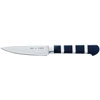
A paring knife is a general purpose knife with a plain edge blade that is used for small intricate work like peeling and coring. A paring knife usually measures between three and five inches on the blade.
Tomato knife
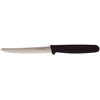
A tomato knife is a small serrated kitchen knife designed to slice through tomatoes. The serrated edge allows the knife to penetrate the skin quickly without crushing the flesh.
Utility knife
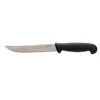
A utility knife is used for general or utility purposes. A utility knife is between a chefs knife and paring knife in size, about four inches and seven inches in length.
Santoku knife

The Santoku is a general-purpose kitchen knife originating in Japan. Its blade is typically between five and eight inches long, has a flat edge and a sheepsfoot blade that curves in an angle approaching 60 degrees at the point. The knife performs well at slicing, dicing and mincing. The Santoku's blade and handle are designed to work in harmony by matching the blade's width/weight to the weight of blade tang and handle.
Turning knife

The turning knife is ideal for shaping, trimming and peeling all types of fruit and vegetables. This knife has a distinctly curved blade and tends to range in size between two and 10 inches.
Browse our full range of chefs knives to get the blade for your food prep needs.