
How Does a Cafetiere Work?
Cafetieres work by allowing coffee to brew without being exposed to either pressure or the boiling process. Instead, coffee infuses gradually in hot water and makes for a richer mouthfeel and great control over how you like your coffee.
Cafetieres provide great-tasting coffee, offer tabletop interaction for your customers and are an essential part of many hotel breakfasts. As such, offering French press coffee will appeal to coffee purists and easily cater for larger numbers of drinkers. It's also much easier to brew with a cafetiere than new users may think, saving valuable time in the long run.
BROWSE ALL CAFETIERESHow To Use a Cafetiere

Get the best possible coffee from your cafetiere by following these simple steps:
- Remove the cafetiere lid and plunger and preheat the cafetiere by filling with boiling water.
- Whilst the cafetiere warms, grind your beans to a medium coarse consistency.
- Empty the cafetiere and place the required amount of coffee in the base (70 grams per litre).
- Top with water which is just below boiling point.
- Replace the lid and plunger, allow to infuse for approximately four minutes.
- Push the plunger down in order to separate the grounds from the brewed coffee. Do not compact the coffee at the bottom, as this will release a bitter taste.
TIP: Some roasters recommend swirling some of the hot water around with your grounds in order to enliven the blend. Do so for roughly thirty seconds before allowing to rest for the remaining three and a half minutes.
How Much Coffee Should I Put in My Cafetiere?
The quantity of coffee you put in your cafetiere depends on three main things:
- The strength of the coffee
- The coarseness of the grounds
- The mineral composition of your water
As a general rule, use approximately 70 - 75 grams of coffee per litre of coffee which you want to produce. This can be adjusted to taste and to suit the coffee which you are using. This equates to roughly one scoop or heaped teaspoon per person (or cup).
TIP: Cafetieres work best with a more coarse grind of coffee. Rather than a fine powder, your beans should have a texture more like sand. Browse coffee grinders in order to make sure your beans are just right.
A Brief History of Cafetieres

Humans have been drinking coffee since the 15th century, but cafetieres as we know them only emerged in the mid-19th century. Dozens of coffee makers were patented in France throughout the 1840's and 1850's, but most of these focussed on ways of boiling water and coffee grounds together or passing the water through grounds. Despite these primitive designs, the English language use of the word cafetiere originated in this period of invention and it is simply the French for 'coffee maker'. This was also the time when coffee drinking rapidly gained popularity throughout Europe and emerged in America.
We took a step closer to modern cafetieres in 1852 when Henri-Otto Mayer and Jacques-Victor Delforge patented their 'Pressure Coffee Maker With Instantaneous Filtration', which was the first coffee pot to use a piston to exclude grounds from water during the pouring process. Unfortunately, limitations in technology made making a watertight seal difficult and many sources claim the resultant invention didn't really work.
DID YOU KNOW: Despite it being a French word, many French people use the word cafetière to refer to filter coffee machines and 'cafetière à piston' (or 'piston coffee maker') to refer to a conventional plunger operated device.
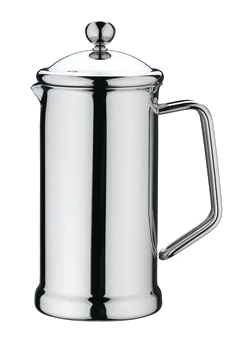
This problem was solved in 1929 when Italian inventor Attilio Callimani patented a revised coffee plunger with a mesh skirt and fine grill. The modern cafetiere was born! His design was refined further in 1957 By Faliero Bondanini who patented a system using flexible fins in conjunction with a spring in order to give the perfect seal. Throughout the 1960's and 1970's the humble coffee plunger became a must-have part of domestic life, aided by several large distributors and the popular Bodum cafetieres.
Choosing a Cafetiere
Cafetiere Sizing
One of the main decisions when buying a cafetiere is trying to choose the correct size. Fortunately, cafetieres are usually labelled for the number of cups of coffee they provide. This generally allows for roughly a 4.5oz or 125ml cup, which leaves space for milk in a modest 6oz cup. If you are serving larger quantities of coffee, 3 cup cafetieres could easily be shared between two or be used for personal use. By comparison, our larger 6 cup, 8 cup, and 12 cup cafetieres are built for generous sharing.
Material
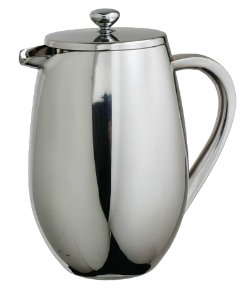
Cafetieres can be made from a range of materials, making choosing potentially difficult. Polycarbonate is an affordable option which is incredibly unlikely to break, but lacks the refinement or luxurious finish of alternative glass cafetieres. Glass is arguably the most common material for manufacturing cafetiere beakers, giving clear and elegant coffee makers which allow for controlled brewing.
Finally, stainless steel and aluminium cafetieres combine the sturdiness of polycarbonate options with contemporary design and unrivalled thermal insulation. The only downside is trying to keep an eye on the progress of your brew!
Design
Most cafetieres feature a main beaker which is either built into the frame, as with some plastic ones, or held and removed from a surrounding frame (as with glass ones). It can be useful to browse a full selection of coffee plungers in order to find the ideal one to suit the look and requirements of your business.
BROWSE ALL CAFETIERESCan i use a cafetiere for tea?
Yes! In fact, Faliero Bondanini's 1929 patent described a cafetiere as 'a device for the filtration of infusions such as tea or coffee'. As such, cafetieres are a good way of brewing loose leaf teas without the risk of drinking leaves. Teabags already provide the necessary separation, so using a cafetiere isn't worth it. As with coffee, it's important to remember not to press too hard and risk releasing bitter flavours.