
What is Sous Vide Cooking?
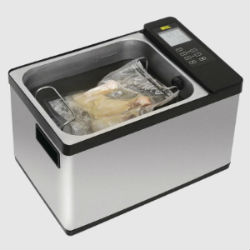
Sous vide, which is French for 'under vacuum' is a method of cooking food sealed in airtight plastic bags in a water bath. It was developed in France in the early 1970's when George Pralus and a food scientist joined forces to devise the perfect method for producing foie gras. After numerous experiments the best method proved to be sealing the food in a pouch by using a vacuum packing machine before cooking it very slowly at a controlled temperature.
Food cooked in this way is cooked for longer than normal cooking times - 72 hours in some cases - at an accurately regulated temperature much lower than normally used for cooking, typically around 55°C to 60°C for meats and higher for vegetables. The intention is to cook the item evenly, and to not overcook the outside while still keeping the inside at the same 'doneness', which keeps the food juicier.
Sous vide allows kitchens to maximise advance preparation. It also reduces wastage, making sous vide a highly cost effective cooking method.
SHOP SOUS VIDEWater Baths
By placing food in a water bath with a temperature set at the final cooking temperature of the food, overcooking can be avoided, as the food cannot get hotter than the bath it is in. In conventional high-heat cooking, such as oven roasting or grilling, the food is exposed to heat levels that are much higher than the desired internal cooking temperature.
Because of the precise temperature control of a water bath and the fact that the bath temperature is the same as the target cooking temperature, very precise control of cooking can be achieved.
Using a Sous Vide
For a quick look over the steps involved in sous vide cooking, watch the video below demonstrating steak being delicately prepared in a portable Buffalo Sous Vide.
Clifton Food Baths
According to Clifton Food Range, cooking at lower temperatures for extended periods of time has a wide range of benefits:
- Minimal loss of moisture and weight
- Preservation of flavour and aroma as water soluble substances - especially aromatics are not lost
- Flavours are enhanced, colours retained and little or no salt is required
- Nutrients are preserved as water-soluble minerals are not leached into cooking water, as cooking in a vacuum bag eliminates this
- Research has shown that sous vide gives the highest retention of vitamins vs. steaming and boiling
- Little additional fat is required during cooking
- Consistent results every time a dish is cooked
Limitation of sous vide cooking
One limitation of sous vide cooking is the fact that browning (Maillard reactions) happens at above the boiling point of water. The flavours and "crust" texture developed by browning are generally seen as very desirable in the cooking of certain types of meat. The flavours and texture produced by browning cannot be obtained by sous vide. In some cases, meats and other foods cooked with the sous vide technique will be browned either before or after being placed in the water bath, using techniques such as grilling. This secondary browning is done briefly, and sometimes at higher heat than normally used, so as to affect only the surface of the food and to avoid overcooking the interior.